🔥 Design Webflow sites with AI


Every hour spent wrestling with complex slider implementations is an hour not spent acquiring new clients, refining designs, or building passive income streams.
The traditional approach to slider development, involving custom JavaScript, debugging cross-browser issues, and endless tweaking, represents a significant drain on freelance productivity that many designers accept as unavoidable.
This assumption deserves challenge. Modern pre-built slider solutions have matured to the point where they offer professional-quality results in a fraction of the development time. Understanding how to leverage these tools effectively can transform your freelance practice, enabling faster delivery, higher client satisfaction, and improved profitability.
Building sliders from scratch carries hidden costs that extend far beyond initial development hours. The debugging phase alone can consume days when cross-browser compatibility issues emerge. Client revision requests multiply development time when changes require code modifications rather than simple adjustments. Maintenance obligations persist long after project delivery when custom implementations need updates or fixes.
Consider a typical custom slider implementation for a client homepage. The initial build might require eight to twelve hours for an experienced developer. Browser testing and bug fixes add another three to five hours. Client revisions requesting different transition effects or navigation styles can add four to eight more hours. The total investment often exceeds twenty hours for a single website component.
Freelancers who track time carefully often discover that complex custom components dramatically reduce their effective hourly rate. A project quoted at a fixed price becomes less profitable with every additional hour invested. The slider that seemed straightforward in the proposal becomes a profitability drain when implementation challenges emerge.
Pre-built solutions compress this timeline dramatically. What previously required twenty hours might now require two to three hours for selection, customization, and integration. The mathematics of freelance profitability shift decisively in favor of leveraging existing solutions rather than reinventing them.
Not all pre-built solutions serve freelance needs equally. The ideal solution for client work must balance several factors including design quality, customization flexibility, ease of implementation, and ongoing maintenance requirements. Solutions that excel in one area while failing in others create problems that offset their benefits.
Clients judge your work by what they see, making design quality non-negotiable. Pre-built solutions must offer visual sophistication that matches or exceeds what custom development would produce. Template designs should feel premium and contemporary rather than generic or dated. The goal is for clients to be impressed by the result without ever knowing or caring whether custom code was involved.
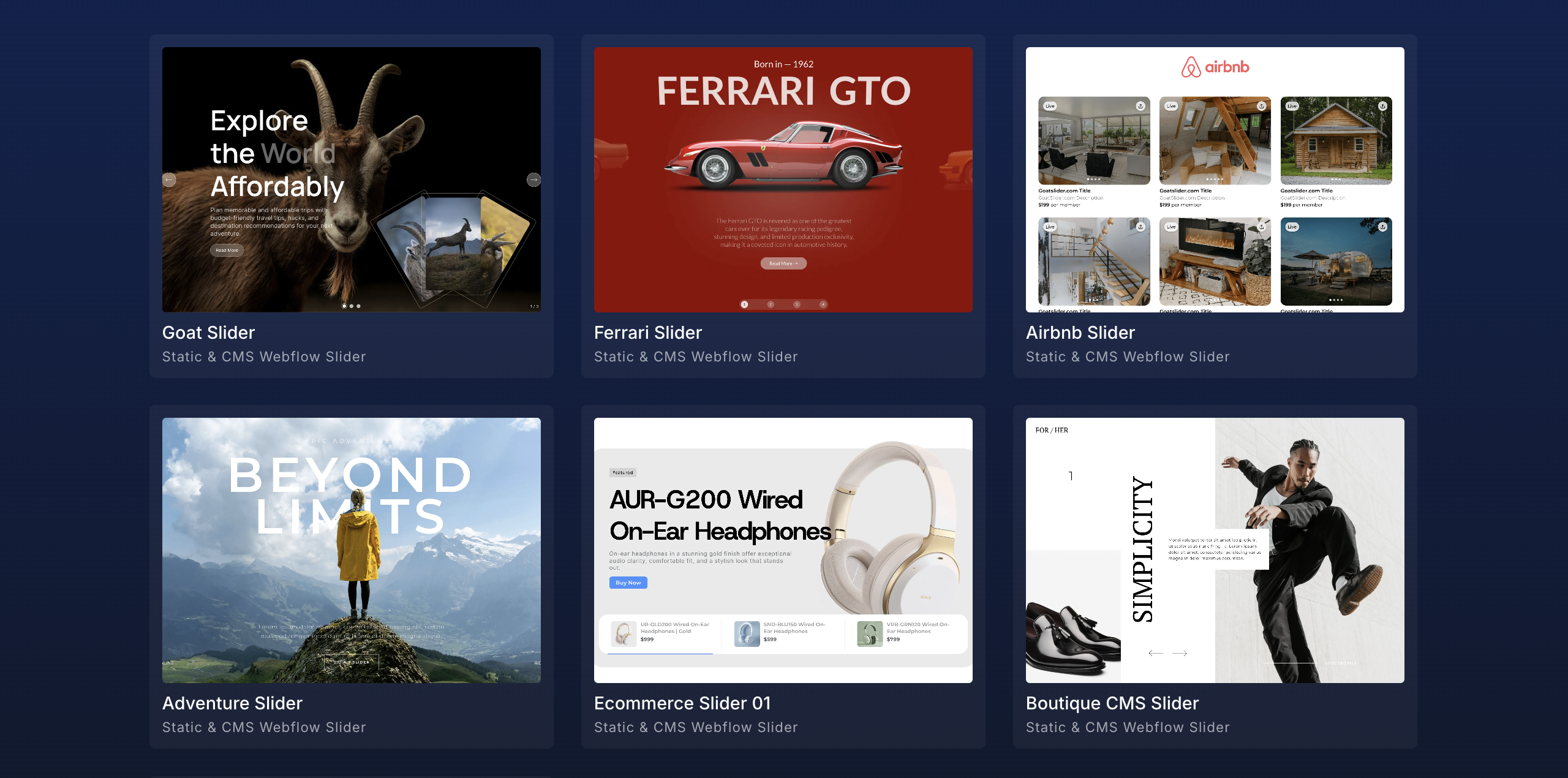
Webflow-native solutions like Goatslider address this requirement by offering templates designed specifically for the platform's capabilities and aesthetic standards. These purpose-built designs integrate seamlessly with Webflow projects, maintaining the visual coherence that custom implementations would provide.
Client projects rarely accept templates without modification. Brand colors need adjustment. Typography must match site-wide standards. Spacing and proportions may require refinement. The value of pre-built solutions depends heavily on how easily these customizations can be accomplished.
Solutions that require code editing for basic customizations undermine their time-saving potential. The ideal approach provides visual customization interfaces that allow adjustments without touching code. Style modifications should feel like design work rather than development work, keeping the process within your core competency.
Efficient integration requires understanding how slider solutions fit within broader Webflow workflows. The goal is seamless incorporation that does not disrupt established processes or require context-switching between different tools and interfaces.
Approaching template selection strategically accelerates project delivery. Before beginning client work, familiarize yourself with available templates and their characteristics. Understand which templates suit different project types. Develop a mental catalog that allows quick matching between client requirements and appropriate starting points.
This upfront investment pays dividends across multiple projects. When a client requests an e-commerce product showcase, you immediately know which template provides the best foundation. When a portfolio project needs a gallery slider, the selection process takes minutes rather than hours of exploration.
Establish consistent customization workflows that you can execute efficiently across projects. Define the sequence of adjustments you typically make: color scheme alignment, typography updates, spacing refinements, content population. Document these workflows so they become automatic rather than requiring fresh problem-solving each time.
Standardized workflows also improve estimation accuracy. When you know exactly what customization involves, you can quote projects confidently and deliver within promised timeframes. This reliability builds client trust and supports premium pricing.
Transparency about your tools and methods, at the appropriate level of detail, supports healthy client relationships. Clients generally care about results rather than implementation details, but occasional questions about your approach deserve thoughtful responses.
When clients ask about your development approach, frame the conversation around value delivered rather than technical details. Explain that you leverage professional-grade components that have been refined through extensive development and testing. Emphasize that this approach enables faster delivery, proven reliability, and cost efficiency that benefits their project.
Avoid defensive postures about using pre-built solutions. The construction industry does not expect every nail and board to be hand-crafted. Software development routinely incorporates libraries and frameworks. Web design appropriately follows the same principle of building on proven foundations.
Pre-built solutions enable faster delivery, but resist the temptation to compress timelines excessively. Build buffer time for unexpected client requests, revision rounds, and integration challenges. Delivering ahead of schedule delights clients; missing compressed deadlines damages relationships regardless of how efficient your process may be.
Use the time savings from efficient slider implementation to improve other project aspects rather than simply accelerating delivery. Higher quality outcomes across all project components serve your reputation better than marginally faster turnaround on slider implementation alone.
The efficiency gains from pre-built slider solutions contribute to broader practice sustainability. Freed time can be invested in business development, skill advancement, or simply maintaining work-life balance that prevents burnout.
Freelancers face inherent scaling limitations when every project requires proportional time investment. Efficiency tools break this constraint by enabling more output per hour worked. The freelancer who delivers four projects monthly using pre-built solutions outearns the one delivering two projects with custom implementations, assuming comparable project values.
This scaling potential supports practice growth without requiring unsustainable working hours. You can increase income while maintaining or even reducing weekly hours invested, creating the lifestyle flexibility that often motivates freelance career choices.
Consider deliberately allocating saved time to high-value activities. Client acquisition efforts generate future revenue. Skill development expands service offerings. Process documentation creates intellectual property that compounds efficiency gains. Strategic reinvestment transforms one-time savings into ongoing practice improvements.
The hours not spent debugging custom sliders could fund a marketing initiative that generates three new client relationships. Those relationships might collectively value more than dozens of hours of implementation work. This leverage effect makes tool efficiency decisions strategic rather than merely tactical.
Tool selection should align with your specific practice characteristics. Consider your typical client types, project scopes, and technical comfort level. The best tool for your practice depends on these contextual factors rather than abstract feature comparisons.
For Webflow-focused freelancers, native solutions that integrate directly with the platform offer significant advantages. Goatslider exemplifies this category, providing slider and carousel templates designed specifically for Webflow implementation. The elimination of platform bridging overhead and the availability of CMS integration support common freelance project requirements.
Evaluate solutions through actual project implementation rather than feature list comparison. Trial implementations reveal practical workflow fit that specifications cannot capture. Invest time in evaluation upfront to ensure confident tool selection that serves your practice across many future projects.
The freelance web design landscape rewards practitioners who work intelligently rather than merely working hard. Pre-built slider solutions represent one component of an efficiency-oriented approach that enables sustainable, profitable freelance practices. The investment in learning and integrating these tools pays returns across every project that benefits from professional slider implementation delivered in a fraction of traditional development time.
Latest Insights
Dive into our blog to discover insightful articles covering a variety of topics tailored for SaaS platforms.

Transform your Webflow slider experience with Goat Slider.


Designed By @OwlsTech Service